How to Predict HTFT Predictions: Half-Time/Full-Time Football Betting Strategy
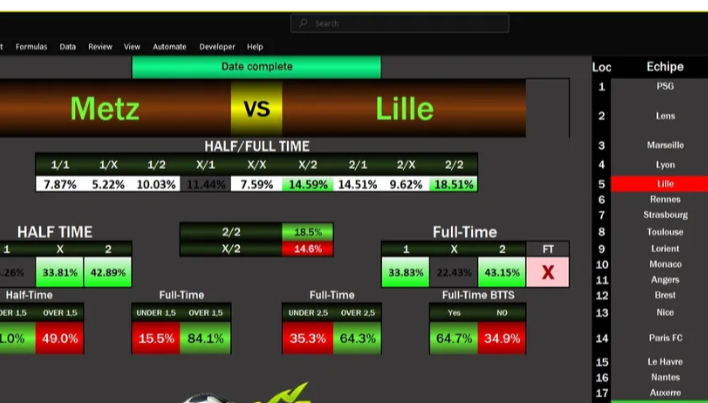
Best Tips on How to Predict HTFT Predictions for Soccer Fans
Incase you have ever wanted to become consistently profitable in the field of sports betting, Worry no more, lets learn how to predict HTFT Predictions Correctly. (Half‑Time/Full‑Time outcomes) is one of the most powerful skills you can develop. HTFT betting requires understanding match flow, team psychology, tactical tempo, scoring timing patterns, and probability modeling. Unlike standard match result betting, HTFT predictions reward bettors who can anticipate how games evolve across two distinct phases.
In this comprehensive guide, you will learn proven analytical frameworks, statistical models, expert heuristics, and data‑driven techniques that professional bettors use to predict HTFT outcomes with higher accuracy. Whether you are a beginner or advanced bettor, this SEO‑optimized resource will help you dominate HTFT markets and outperform competing prediction sites.
What Are HTFT Predictions?
(Half‑Time/Full‑Time Explained)
HTFT (Half‑Time/Full‑Time) betting predicts the result at half‑time AND full‑time. There are 9 possible combinations:
| Half‑Time | Full‑Time | Code |
|---|---|---|
| Home | Home | HH |
| Home | Draw | HD |
| Home | Away | HA |
| Draw | Home | DH |
| Draw | Draw | DD |
| Draw | Away | DA |
| Away | Home | AH |
| Away | Draw | AD |
| Away | Away | AA |
This market rewards bettors who can forecast match momentum changes — for example, teams that start fast but fade, or slow starters that dominate late.
Why HTFT Predictions Are Highly Profitable
Many sportsbooks misprice HTFT markets because predicting match phases is harder than predicting final results. Bettors who understand tempo shifts and scoring windows gain a statistical edge.
Key advantages:
- Higher odds than standard 1X2 betting
- Exploits tactical mismatches
- Captures comeback probability
- Uses deeper statistical patterns
- Less efficient market pricing
Core Principle: Matches Have Phases
Football matches are not static. They evolve across phases:
- Opening pressure phase (0–20 min)
- Tactical control phase (20–45 min)
- Adjustment phase (45–70 min)
- Fatigue & risk phase (70–90 min)
HTFT prediction accuracy depends on identifying which team controls which phase.
How to Predict HTFT Predictions Using Data‑Driven Match Phase Analysis
Understanding match phase dominance is the foundation of accurate HTFT betting.
Step 1: Analyze First‑Half vs Second‑Half Goal Distribution
Teams often show consistent scoring timing patterns.
Example metrics:
- % goals scored in first half
- % goals conceded in second half
- Early goal frequency (0–30 min)
- Late goal frequency (60–90 min)
Interpretation examples:
- Fast‑starting team vs slow starter → HH or HD
- Late‑surging team vs early leader → DH or AH
Step 2: Evaluate Comeback and Collapse Tendencies
Some teams frequently lose leads; others recover strongly.
Key stats:
- Points gained from losing positions
- Points lost from winning positions
- Second‑half xG vs first‑half xG
- Goals conceded after 60′
High comeback teams create strong DH and AH opportunities.
Step 3: Identify Tactical Tempo Profiles
Teams generally fall into tempo archetypes:
| Type | Description | HTFT Impact |
| Fast starters | Early pressing | HH, HD |
| Slow starters | Gradual buildup | DH, DA |
| Second‑half teams | Fitness dominance | DH, AH |
| Defensive openers | Conservative first half | DD, DH |
Tempo profiling dramatically improves HTFT accuracy.
Advanced Statistical Models for How to Predict HTFT Predictions
Professional bettors use probability modeling to estimate HTFT outcomes.
Poisson Phase Model
Separate expected goals for each half:
- xG₁ = expected first‑half goals
- xG₂ = expected second‑half goals
Calculate probabilities independently, then combine HT and FT states.
This produces realistic HTFT probabilities rather than guesswork.
Transition Probability Model
Estimate probability of state changes:
P(HT=Home → FT=Home)
P(HT=Home → FT=Draw)
P(HT=Home → FT=Away)
These are derived from historical league data.
Example insight:
- Home lead at HT converts to win 72% of time
- Home lead becomes draw 18%
- Home lead lost 10%
This enables pricing HH vs HD vs HA accurately.
Momentum Decay Modeling
Teams lose dominance over time.
Variables:
- Fitness rating
- Squad depth
- Press intensity
- Schedule congestion
High decay teams → HD or HA outcomes.
How to Predict HTFT Predictions from Tactical Matchups
Tactics determine phase dominance.
Pressing vs Low Block Dynamics
High press teams score early. Low block teams resist early but concede late.
Pattern:
Press team vs low block → HH or DH depending stamina.
Possession vs Counterattack
Possession teams often dominate later once space opens.
Counter teams score early transitions.
Pattern:
Counter vs possession → AH or DH.
Formation Fatigue Effects
High‑intensity formations (3‑4‑3, 4‑3‑3 press) decline late.
Compact formations (5‑4‑1) stay stable.
HTFT implication:
- High intensity team HT lead → HD risk
Psychological Factors in HTFT Prediction
Human factors strongly affect phase results.
Motivation Asymmetry
Examples:
- Underdog high first‑half energy
- Favorite patient dominance
Pattern:
Underdog HT lead → AH or HD.
Game State Behavior
Teams change strategy after leading:
- Defensive retreat
- Possession control
- Risk reduction
This creates draw or comeback probability.
Crowd Pressure and Momentum
Home teams often surge late from crowd energy.
Pattern:
Draw HT → Home FT (DH).
League‑Specific HTFT Patterns
Different leagues show different phase trends.
High‑Tempo Leagues
Examples: Premier League, Bundesliga
Traits:
- Early goals
- Transitions
- Comebacks
Strong HTFT types:
HH, AH, DH.
Tactical Leagues
Examples: Serie A, La Liga
Traits:
- Controlled first half
- Late breakthroughs
Strong HTFT types:
DD, DH, DA.
Defensive Leagues
Examples: Ligue 1, lower divisions
Traits:
- Low scoring first half
- Stable results
Strong HTFT types:
DD, HH, AA.
Step‑by‑Step System: How to Predict HTFT Predictions Accurately
Follow this professional workflow.
Step 1: Collect Phase Statistics
- First‑half goals scored
- Second‑half goals scored
- First‑half conceded
- Second‑half conceded
- HT vs FT results history
Step 2: Rate Teams by Phase Strength
Create ratings:
- Early strength score
- Late strength score
Step 3: Compare Phase Matchup
Example:
Team A strong early
Team B strong late
→ HT: A
→ FT: B
→ AH
Step 4: Adjust for Context
Consider:
- Injuries
- Rotation
- Motivation
- Fixture congestion
Step 5: Calculate Probability Edge
Bet only if:
Model probability > bookmaker implied probability.
HTFT Prediction Examples
1: Fast Starter vs Late Finisher
Team A:
- 65% goals first half
Team B:
- 68% goals second half
Prediction:
HT: A
FT: B
→ AH
2: Dominant Favorite vs Weak Underdog
Favorite scores early and maintains control.
Prediction:
HH
Example 3: Balanced Teams with Late Goals
Both score mainly late.
Prediction:
DH or DD
Common Mistakes in HTFT Betting
Ignoring Phase Data
Most bettors only check final results.
HTFT requires timing analysis.
Overvaluing Favorites
Favorites often concede late.
HH odds overpriced.
Ignoring Substitution Depth
Bench strength affects second half.
Small Sample Bias
Use at least 10–15 matches.
Professional Tips to Improve HTFT Accuracy
- Track minute‑by‑minute goals
- Analyze xG by half
- Study tactical matchups
- Use league transition rates
- Model probabilities
HTFT Prediction Strategy for Long‑Term Profit
Focus on Value, Not Frequency
Only bet when edge exists.
Specialize in Specific Leagues
Patterns vary widely.
Track Results and Refine Model
Data feedback improves accuracy.
FAQ: How to Predict HTFT Predictions
What is the best way to predict HTFT outcomes?
The most accurate method combines phase statistics, tactical analysis, and probability modeling rather than relying on simple team strength comparisons.
Are HTFT bets profitable long term?
Yes, because sportsbooks price them less efficiently than standard markets. Skilled bettors can exploit timing patterns.
Which HTFT outcome occurs most often?
HH is most common when favorites dominate early and maintain control.
Is HTFT harder than match result prediction?
Yes. It requires predicting match evolution, not just final strength.
How many matches of data are needed?
At least 10–15 recent matches per team for reliable phase patterns.
Wikipedia Reference on Football Match Structure
For a deeper understanding of football match phases and structure, see:
https://en.wikipedia.org/wiki/Association_football
Conclusion: How to Predict HTFT Predictions
Learning how to predict HTFT Predictions gives bettors a structural advantage because it models football matches as dynamic processes rather than static outcomes. By combining phase statistics, tactical understanding, and probability modeling, bettors can identify mispriced HTFT odds and achieve long‑term profitability.
For consistently accurate HTFT predictions, always analyze:
- Phase scoring patterns
- Tactical tempo matchups
- Comeback tendencies
- League transition rates
- Contextual factors
When applied systematically, HTFT prediction becomes one of the most powerful football betting strategies available.
Comments are closed.